

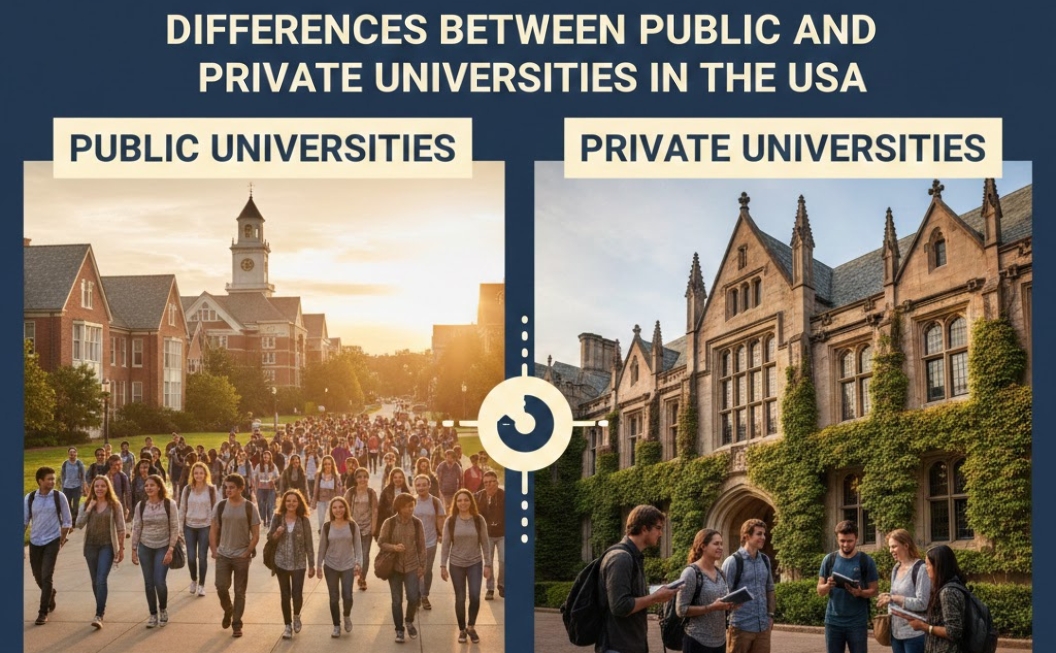
Choosing a university in the United States can feel like standing at a crossroads with dozens of signs pointing in every direction. When I was doing my own research years ago, the first big question that kept popping up everywhere was this:
📌 Should I go to a public university or a private university?
At first glance, the difference seems simple — one is funded by the government, the other isn’t. But once you dig deeper, you realize the variations stretch into lifestyle, cost, campus culture, academic choices, and even the way you’re taught.
So this guide breaks everything down for you — clearly, honestly, and from a student-experience point of view. Whether you’re an international student dreaming of studying in New York or a local American senior unsure which application to prioritize — this is for you.
🎓 What Makes a University “Public” or “Private”?
Public Universities
These schools are funded mainly by state governments. Because of this, they often give price advantages to students from that same state. Examples include:
- University of California, Los Angeles (UCLA)
- University of Michigan, Ann Arbor
- University of Texas at Austin
- Penn State University
They are usually bigger, have more majors, and are often deeply connected to local industries and communities.
Private Universities
Private schools are funded primarily through tuition fees, donations, trusts, and endowments — not the government. Famous names include:
- Harvard University
- Stanford University
- Massachusetts Institute of Technology (MIT)
- Duke University
They tend to be smaller, more selective, and known for strong networks and personalized education.
🧍♂️🧍♀️ Size and Campus Population
One of the biggest visible differences is campus size — which dramatically shapes student life.
Public Universities: Big, Busy, Buzzing
Most public universities have:
➡️ 20,000 to 60,000+ students
➡️ Huge campuses full of clubs, sports, and academic diversity
There’s always something happening. You’ll meet people from everywhere, and class sizes can feel like a mini-movie theater during freshman year.
Pros:
- Endless social and academic options
- Major college sports culture
- Easier to blend in and reinvent yourself
Cons:
- Large lecture halls
- Professors may feel less accessible
- Harder to stand out
Private Universities: Close-Knit, Personalized
Typical school size ranges from:
➡️ 2,000 to 15,000 students
Walking across campus, you’ll probably bump into someone you know. Professors recognize your name by Week 2.
Pros:
- Smaller classes
- Strong mentorship and community
- A comfortable learning environment
Cons:
- Limited major options
- Smaller friend-pool
- Fewer huge sporting events (except Notre Dame or USC!)
💰 Cost: The Elephant in the Room
If we’re being real — university pricing in the U.S. is shocking for many people.
Public University Cost Breakdown
| Student Type | Average Annual Tuition |
|---|---|
| In-state | $9,000 – $12,000 |
| Out-of-state | $25,000 – $35,000+ |
For example, if you live in California, studying at UCLA is much cheaper than if you’re from Texas.
Private University Cost Breakdown
| Student Type | Average Annual Tuition |
|---|---|
| All students | $35,000 – $60,000+ |
Yes, that’s a big leap. But…
✨ Many private schools offer massive scholarships thanks to donor funding.
✨ Some top private universities guarantee full financial aid for lower-income families.
So, don’t rule them out just by seeing the price tag.
🌍 Diversity and Student Population
Public Schools: A Melting Pot of the State
Public universities welcome large numbers of local state students, but also attract:
- Out-of-state students
- International students
- Transfer students from community colleges
You’ll find tons of people from every background and interest group.
Private Schools: National and Global Appeal
Top private universities often pull students from:
- All 50 U.S. states
- 100+ countries
Walking into a private university dorm can feel like you’ve stepped into a mini United Nations.
🧑🏫 Faculty and Teaching Styles
Public Universities
Public campuses often have world-renowned researchers. But since research funding is a priority, some professors spend more time publishing papers than working with students.
Freshman year might look like:
🧍♂️ + 399 other students listening to a lecture on a giant screen
You need to take initiative if you want close mentorship.
Private Universities
Teaching quality is often the core mission.
- Smaller classes = More discussions
- Professors often focus more on teaching
- Personal feedback and relationships are easier to build
Some students thrive in this environment. Some prefer independence. It’s all about knowing what works for you.
📚 Academic Majors & Research Opportunities
Public Universities = The Costco of Majors 😄
It’s not unusual for a state university to offer:
✔ 150+ undergraduate majors
✔ Niche programs like Marine Biology, Urban Forestry, Space Science
✔ Huge labs and funded research centers
There’s room to explore — switch majors once, twice… or five times.
Private Universities = Focused Excellence
Private schools sometimes offer fewer majors, but what they do offer is polished like a diamond.
Examples:
- MIT — Engineering & Computer Science
- Juilliard — Performing Arts
- Babson College — Entrepreneurship
If you already know your passion, a private school with a famous program can be a perfect match.
🏆 Reputation: Rankings & Prestige
This is where marketing — and reality — collide.
Public Schools Shine In:
- Engineering (e.g., Georgia Tech)
- Business (e.g., University of Michigan)
- Agriculture & applied sciences
Many have global reputations that rival private schools.
Private Schools Lead In:
- Ivy League branding
- Alumni influence
- Long-standing prestige
Names like Harvard, Princeton, or Yale open doors just by existing on your resume. That network? Priceless.
🏡 Campus Culture & Social Life
Public Schools: “Welcome to the Party!”
Picture:
- Massive football stadiums
- Homecoming parades
- Greek life (fraternities & sororities)
- Concerts, festivals, clubs everywhere
Every weekend something happens. It’s easy to find your tribe.
Private Schools: More Community, Less Chaos
Social life feels more like:
- Dinners in faculty houses
- Close friend circles
- Cultural communities growing tight bonds
- High focus on academics
They still party — just not at “ESPN highlights” level 😅
🎯 Admission Standards & Competitiveness
Public Universities
Admission is often:
📌 Flexible for in-state students
📌 Competitive for out-of-state and international applicants
Some schools like UC Berkeley or UVA are extremely selective, but many state universities offer broad access.
Private Universities
Private admissions can feel like trying to win a golden ticket:
- Holistic evaluation
- Emphasis on unique achievements
- Strict financial documentation for internationals
Your essay, passion, and story matter more than just grades.
🛠 Career Support & Alumni Networks
Public University Strengths
- Strong ties to local employers
- Great for students who want to work in the region
Private University Advantage
- Alumni often hold influential roles worldwide
- Career centers invest heavily in students
- Mentorship programs are top-notch
Want to work on Wall Street? A private-school network might help.
🧳 International Student Experience
International students quickly notice the difference:
| Feature | Public University | Private University |
|---|---|---|
| International student population | Larger | Smaller |
| Cultural clubs | Many options | More limited but close-knit |
| Visa & support services | Solid | Often more personalized |
| Networking opportunities | Broad | Higher-level contacts |
If you want strong community support and academic attention — private helps.
If you want a bustling social scene and variety — public wins.
📝 Scholarships & Financial Aid
Public Universities
- Strong aid for in-state residents
- Limited scholarships for international students
Private Universities
- Need-based aid can sometimes cover most tuition
- More scholarships open to all students
There are private students who pay less than many public university students — shocking but true.
🌱 What Type of Student Thrives Where?
Here’s a quick reflective guide 👇
Choose a Public University if you want:
✔ Big-campus adventure
✔ Many academic and social paths to explore
✔ Strong public school affordability (especially in-state)
✔ Division I sports and huge campus spirit
Choose a Private University if you want:
✔ Personal attention from mentors
✔ Smaller class sizes
✔ Prestige and powerful alumni networks
✔ A selective environment focused on excellence
Neither is better for everyone — it’s about who you are becoming.
🏁 So… Which One Should You Choose?
Let me tell you a secret:
➡️ The best university is the one that helps you thrive — academically, socially, and financially.
Your choice should come from:
- Where you feel motivated
- Where you feel supported
- Where you believe you’ll grow
Here are a few final questions for self-reflection:
🧠 Do I learn better in smaller, personal settings or big, vibrant ones?
📌 Do I have a clear major or still exploring?
🌍 Do I want a diverse social environment or a tight community?
💵 Can I handle higher costs, or should I prioritize affordability?
🏆 Is prestige important for my career path?
Take your time — the right choice isn’t about label, but fit.
💬 Final Thoughts
I’ve seen students from tiny private colleges change the world.
I’ve seen graduates from huge public universities invent the future.
Both campuses have magic — just different types.
And maybe your journey will include stumbling into the wrong lecture hall, cheering at a football game you don’t understand, or finding your future best friend in a dorm common room. That’s the beauty of U.S. university life — wherever you go, you will grow.